
You want more privacy in the back of the car, but leaving it at a workshop means arranging a lift and losing half a day. Mobile tinting can solve that. It becomes less convenient if the installer arrives and finds there is no room to open the doors, or the only parking space is exposed to wind and rain.
The useful question is not just “Can you come to me?” It is “Can you do this particular job properly at my address, for the price you have quoted?” This guide helps you get a clear answer. For an overview of the services themselves, see our car window tinting options.
How does mobile window tinting work?
A mobile specialist agrees the work and location in advance, checks the existing glass, prepares the surfaces and fits film cut to the vehicle. Standard automotive tint is usually installed on the inside of the glass, as LLumar explains in its automotive FAQ. Seeing film shaped against the outside during preparation does not necessarily mean it will stay there.
Start with the make, model, year and body style. “A Golf” leaves room for misunderstanding; the number of doors and separate panes can change the job. Say whether you mean the rear passenger windows and rear screen, or something else. Send pictures of existing film, damaged edges or unusual glass if requested.
Ask who will do the installation and who handles a problem afterwards. If an enquiry goes through an intermediary, establish the installer’s name and the party taking payment before you agree to the appointment.
How much does mobile car window tinting cost?
There is no single UK mobile tinting price. A quote for one rear screen cannot be compared directly with one for every pane behind the driver. Film specifications, access, removal and travel can all change the total.
A published price reference
When checked on 16 September 2026, Road Radio’s tinting price list showed £119.99 for a rear window, £169.99 for a small car with three windows and £219.99 for a large car with five windows, including VAT. These are one business’s advertised prices, not a national average or a quote from Mobile Tinting UK. Its tinting page describes branch installations; confirm any mobile availability and travel charges separately.
Use published prices to understand scale, then obtain a written quote for your own car. A low starting price may be perfectly legitimate, but it tells you little until you know what is included. “Full car” is especially vague and should never be taken to mean that every window can legally receive dark film.
| Item | What to ask | Why it matters |
|---|---|---|
| Glass coverage | Which individual panes are included? | Rear quarter glass and a large rear screen can change the scope. |
| Film | What brand, product range and shade will you fit? | “Premium” alone is not a specification. |
| Old film | Does the price include removal and adhesive clean-up? | Replacing failing film adds work. |
| Visit costs | Are travel, parking and any applicable VAT included? | The headline price may not be the final bill. |
| Aftercare | Who handles defects, and what does the written warranty cover? | Product cover and installation cover may differ. |
Two quotes, two different jobs
Suppose one installer offers rear tinting with a named dyed film. Another includes ceramic film and removal of your existing tint. The second quote may be higher because the scope is different. Ask both businesses to price the same panes, product specification and removal work before deciding which is better value.
If your aim is simply rear-seat privacy, you may not need the most expensive heat-control product. If heat is your main complaint, ask for performance figures before paying for the upgrade.
Can your car be tinted on the driveway?
Possibly, but a parking space is not automatically a suitable installation space. Ask the specialist to approve the location before booking. Tell them about shelter, lighting, room beside the car and any restrictions on working there.
The problem: “I have a driveway, but no garage.”
A practical solution: send a photograph of the space and ask what shelter the installer provides or needs. Agree what happens if weather makes the job unsuitable. If neither of you can provide the required conditions, a workshop appointment may be the better choice.
A garage also needs enough usable space. A car that only just fits between stored boxes leaves little room to work beside an open door. At an office, obtain permission to use the parking area and check whether barriers, permits or time limits could interrupt the visit. Do not assume the technician brings independent power or can use an outdoor socket: ask.
Mobile or workshop: choose for the job
Mobile installation is useful when the location is workable and travel is inconvenient. A workshop is worth considering if your parking is exposed, the job involves extensive old-film removal or you cannot keep the vehicle accessible for the agreed period. Ask the installer what they recommend for your circumstances rather than treating one format as automatically better.
Choose the film for the problem you want to solve
Write down the priority before looking at shades: privacy in the rear seats, glare, cabin heat or replacing unattractive old tint. The shade describes only part of what you are buying.
Visible light transmission (VLT) describes how much visible light passes through. Lower figures mean darker glass or film. Heat rejection and UV performance are separate measurements. LLumar’s automotive performance sheet lists them in separate columns for that reason.
Privacy is about shade; heat control needs more information
Dyed film is an option to discuss for appearance and privacy. Ceramic products are worth comparing when heat control is a priority. Ask for the precise product data, including total solar energy rejection, at a comparable VLT. A description such as “ceramic” or a single infrared rejection number does not give you the whole comparison. Check the test conditions too: figures measured on different glass are not necessarily like for like.
A manufacturer’s published figures apply to the specified product and test setup. They are not a promise of a fixed temperature drop in your parked car. For example, 3M’s automotive support guidance describes solar control through reflection and absorption. Treat tint as one part of cabin comfort, alongside ventilation and air conditioning.
Look through the sample as well as at it
When possible, view a sample from inside the vehicle. Think about reversing into an unlit driveway or checking through the rear side glass at dusk. A dark rear tint may give the appearance you want in daylight but feel less useful in low light.
If the car already has dark factory glass, ask what an additional film would achieve. Appearance alone cannot tell you the existing glass specification. Explain the problem you still have, then ask whether the proposed product addresses it without making the view unnecessarily dark.
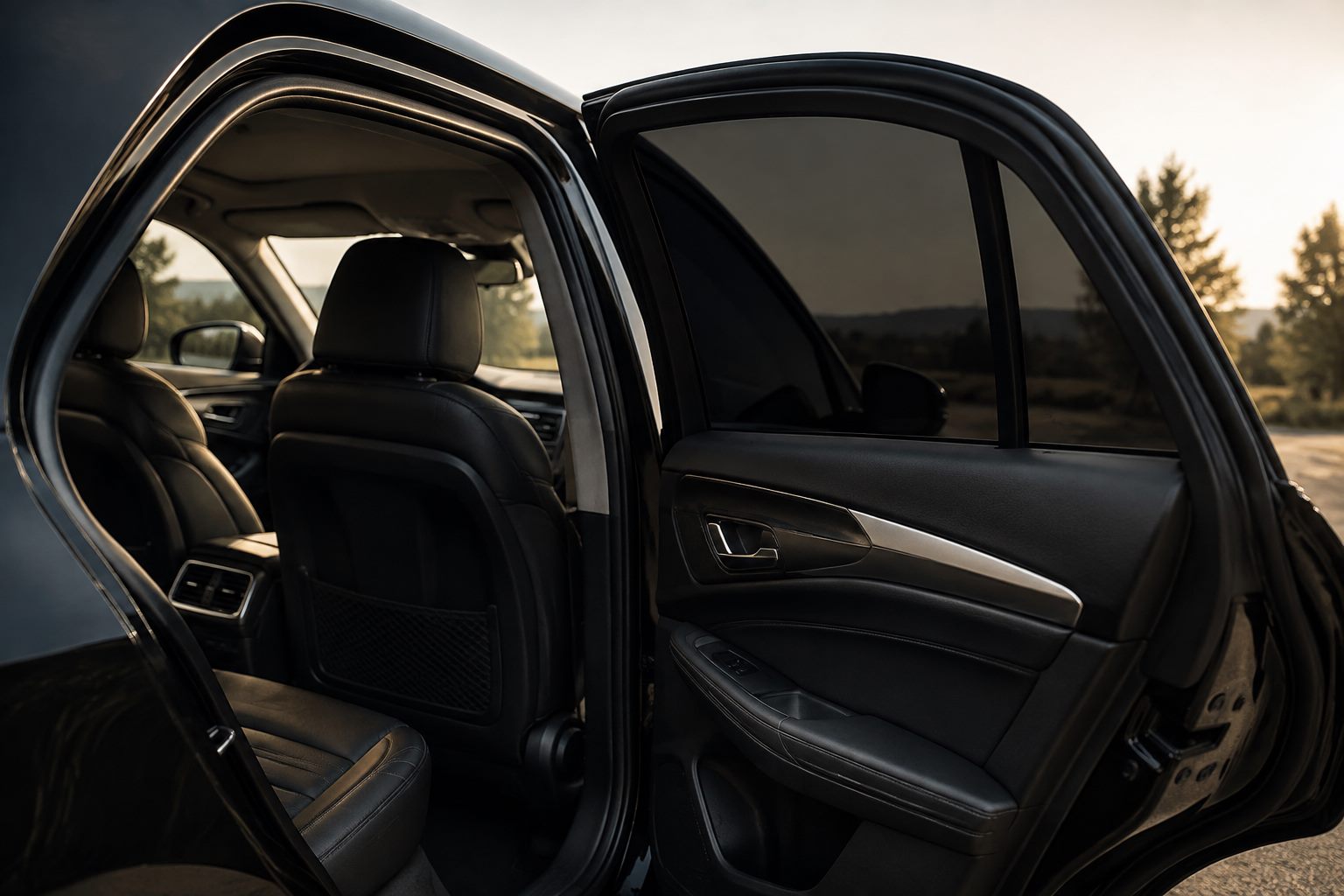
Which car windows can you legally tint in the UK?
The GOV.UK tinting rules distinguish front glass from rear glass and use the date the vehicle was first used.
| Window | First used on or after 1 April 1985 | First used before 1 April 1985 |
|---|---|---|
| Windscreen | 75% | 70% |
| Front side windows | 70% | 70% |
| Rear screen and rear passenger windows | No equivalent VLT limits in this guidance | |
These thresholds concern light passing through the finished window. The percentage printed on a film sample does not prove that the film and existing glass together meet them.
Ask for a measured assessment before agreeing to film on front glass. A shade name, “clear” label or photograph cannot establish compliance. Our homepage also has a brief summary of UK tinting rules.
What happens on installation day?
The exact fitting method varies with the vehicle and film. Your booking should leave time for preparation and a handover, not just the application itself.
Confirm the work before fitting starts
Check the agreed panes, shade and final price with the person doing the job. Point out existing scratches, damaged trim and old-film defects. If the specification changes, agree the change before work begins.
Give the installer access
Remove loose belongings around the working area and make the keys available. Ask in advance whether child seats or a parcel shelf need moving. Let the specialist handle the final glass preparation rather than applying your own polishing products immediately before the visit.
Allow time for a finish check
At handover, inspect the edges and view through each treated pane with the installer. Ask them to identify anything expected to settle during drying and anything that needs another look. Take the receipt and care instructions before they leave.
How long should you set aside?
Ask for an arrival window, estimated working time and likely handover time for your car. A single pane and a rear section with old film to remove are different appointments. Do not plan a fixed departure straight after an estimate unless the installer has confirmed it is realistic.
Installation time and curing time are also different. The technician can finish the visit while the film still needs time to bond and dry. You will need to follow the product’s restrictions after the car is handed back.
Aftercare: what to do, and when to call the installer
Get the instructions for the actual film fitted. As one specific example, 3M’s window tint care guide says not to operate or clean the treated windows for at least 48 hours. It recommends soft cleaning materials and non-abrasive, pH-neutral cleaners. Other products or conditions may need different waiting periods; use the instructions supplied with your installation.
Before the visit, think about anything that requires lowering a window: a car-park ticket barrier, a drive-through or your usual gate. Ask the installer how to handle it during the initial waiting period.
| What you notice | Useful next step |
|---|---|
| Haze or moisture-like patches soon after fitting | Ask whether this is expected for your film and when it should clear. Record a photo to compare later. |
| An edge lifting or a visible crease | Contact the installer promptly. Do not press, puncture or trim it yourself. |
| Marks that remain beyond the stated drying period | Send photographs and request an inspection under the agreed aftercare terms. |
| Visibility that feels unsafe | Have the issue assessed before driving in conditions where you cannot see adequately. |
Keep a record of the product name and shade, treated panes, fitting date and any warranty registration. A promise of a “lifetime warranty” needs written terms: what is covered, who provides the remedy and whether the cover stays with the car or its owner.
Before you book: a message that gets a useful quote
Give each installer the same brief. It cuts down the back-and-forth and makes replies easier to compare.
“I have a [year, make, model and body style]. I want [specific windows] tinted for [privacy / glare / heat control]. There is [no existing film / existing film to remove]. The car will be at [area], with [description of parking and shelter]. Please confirm the film brand, range and shade, the total fitted price including any applicable VAT and travel, the time needed, and the warranty and aftercare terms.”
Before paying a deposit, confirm what happens if the weather prevents the visit, how cancellation works and whether the person quoting is also responsible for aftercare. If you are unsure what service to request, start with the service descriptions on Mobile Tinting UK.
Choose the quote you can explain back in plain English: these panes, this film, this price, at this location, with this aftercare. That is a firmer basis for booking than a shade photograph and an attractive starting price.
Quick questions about mobile car tinting
Is mobile tinting cheaper than going to a workshop?
Not necessarily. Travel may add to a mobile quote, while a workshop quote may have a different film or scope. Compare the same panes, product and included work, then consider the time and travel you save.
Does a darker tint always reject more heat?
Shade alone does not tell you the heat performance. Compare the named film’s solar energy rejection figures at similar VLT levels and check how those figures were measured.
Can I request tinting for rear windows only?
Yes. Specify the rear door panes, quarter glass and rear screen you want included. Avoid relying on “rear half” if either of you could mean a different set of windows.
Can I book a specialist through this website?
Local specialist search is temporarily unavailable while we update the service. This article is an independent guide, not a booking confirmation or a claim that an installer is available in your area.
Sources and editorial notes
Sources checked on 16 September 2026. Prices are a dated example from an independent business and may change. Manufacturer information describes its own products; confirm UK availability and terms with the installer.
- GOV.UK: tinted vehicle windows and the law — front-glass thresholds and vehicle dates.
- Road Radio: published window tinting prices — the price examples above.
- LLumar: automotive window tint FAQ — where standard tint is fitted.
- LLumar: automotive film performance data (PDF) — distinct VLT and solar performance measures; North American product sheet.
- 3M: automotive film support — how solar-control film works.
- 3M: care instructions for window tint — a product-specific aftercare example.
About this guide: published by Mobile Tinting UK, an independent website about mobile automotive window tinting. This is researched guidance, not a report of our own installations or product testing. For an editorial correction, email info@mobiletintinguk.com.